

4 Nov 2026
By Emily Booroff, Social Climbers · 11 min read
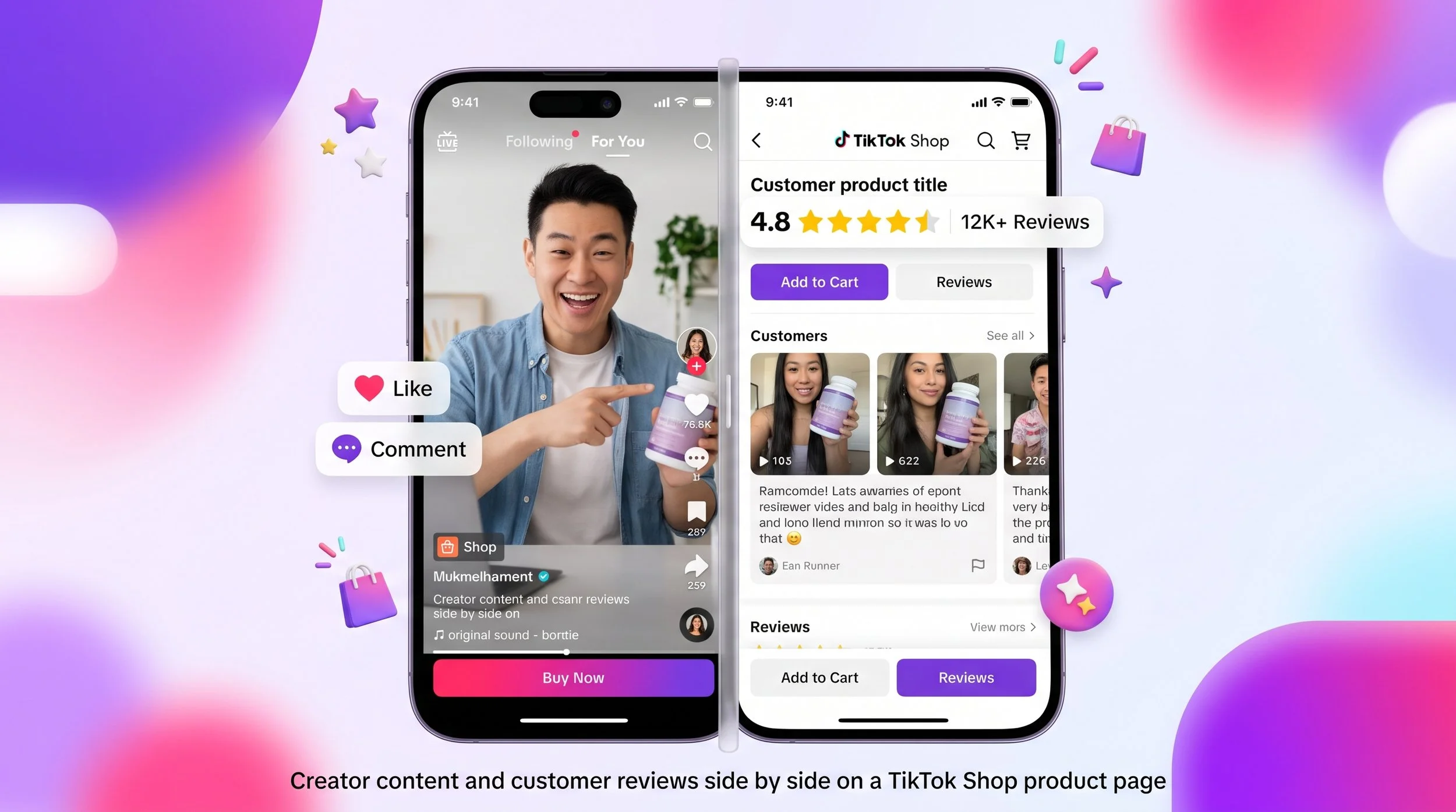
Your customers say they trust reviews. Your budget says creators.
That gap is the most useful thing in social commerce right now, and two surveys published in October 2026 put numbers on it. One, from Bazaarvoice, asked UK consumers what matters when they buy on TikTok Shop. The other, from DoubleVerify, asked 22,000 consumers worldwide how social platforms shape what they buy.
Read side by side, they don't crown a winner. They show a tension. Stated trust leans towards reviews. Creator content still drives discovery. And social ad budgets are growing faster than any of the trust measures.
If you're a marketing director deciding how to split budget between creators, reviews and paid, this is the piece we'd want you to read before your next planning meeting. We'll walk through what each survey actually measured, what neither can tell you, and the four moves we'd make with the evidence as it stands.
Key Takeaways
In Bazaarvoice's UK survey, 74% of TikTok-shopping respondents named star ratings and customer reviews as the most important factor in their buying decision. Just 31% named influencer endorsements.
In DoubleVerify's global survey, 25% of respondents said they'd bought directly on a social platform in the past year, down from 30% in last year's edition. The share saying influencers affect their purchases dropped from 54% to 48%.
Over the same period, global social ad spend for 2026 is forecast to rise around 19%, according to EMARKETER figures cited by DoubleVerify.
These are different surveys, with different questions, samples and markets. They can't be stacked head to head, and neither proves reviews "beat" creators.
The practical read: creators and reviews do different jobs. Creators earn attention; proof earns the purchase. Most brands fund the first and leave the second to chance.
The fix is a system: capture reviews into Shop and ads, brief creators to produce reusable proof, and measure each layer against its own job.

Do customers trust reviews more than influencers on TikTok Shop?
In one UK survey, yes, by their own account. Bazaarvoice's research, reported by Retail Times on 22 October 2026, found that 74% of TikTok-shopping respondents rated star ratings and customer reviews as the most important factor in their buying decision.
The rest of the ranking is just as telling. Customer photos and videos came second, cited by 56% of those respondents. Influencer endorsements came third, at 31%.
The same survey points to a big, active audience. Some 66% of UK respondents said they now buy on TikTok Shop, and one in five said they use it at least weekly. And 68% said they were more likely to trust an everyday customer than an influencer when buying on the platform.
But the survey doesn't write creators off. 64% of respondents said they use TikTok Shop to discover new brands and trends, and 40% said creator content triggers them to buy. Three quarters said they'd bought something there they wouldn't have considered buying elsewhere.
Put simply: respondents say creators get them to the product, and other customers get them over the line.
Watch Out: This is self-reported, stated preference. It tells you what respondents say matters, not what they did. The published coverage doesn't give the sample size, fieldwork dates or exact question wording [VERIFY with Bazaarvoice]. The 74%, 56% and 31% add up to more than 100%, which suggests respondents could choose several factors [VERIFY]. And Bazaarvoice sells review and user-generated content technology, so it has a commercial interest in the finding. None of that makes the data wrong. It means you read it as a signal, not a verdict.
Is influencer impact on purchases falling?
In DoubleVerify's global survey, the reported figure is lower than last year's, but read the fine print before you cut anything. DoubleVerify's second walled-garden report, Scroll, Stop and Shop, was covered by PPC Land on 14 October 2026. It surveyed 22,000 consumers in 21 countries and 2,020 marketers in 25 countries. Sapio Research ran the fieldwork through online panels in February 2026.
Three numbers matter for this conversation:
Buying on social: 25% of consumer respondents said they'd bought something on a social platform in the past 12 months. Last year's edition reported 30%.
Influencer impact: 48% said influencer content had a somewhat-to-significant impact on their purchases. Last year's edition reported 54%.
Spend: the report cites an EMARKETER forecast of $408 billion in global social media ad spend for 2026, up 19% on 2025.
The regional detail matters for UK brands. Influencer impact was reported at 40% in Europe, the Middle East and Africa, against 57% in Latin America. Short-form video was the ad format most likely to prompt action globally (38%), but only 29% of EMEA respondents said the same.
The marketer side of the survey is revealing too. Calculating ROAS or ROI was the second-biggest challenge marketers named, at 36%, just behind audience reach at 40%. The report's own read is that marketers are now more focused on proving spend worked than on finding audiences.
Watch Out: The year-on-year drops are PPC Land's comparison, not DoubleVerify's. PPC Land notes that DoubleVerify doesn't make the purchase or influencer comparisons itself, and that the 2025 question wording isn't reproduced, so some of the fall could reflect changes in how questions were asked. The spend figure is a forecast, not a measurement, and forecasters differ: WARC puts 2026 social ad spend growth at 21.3%. DoubleVerify also sells verification and measurement tools. Treat the trend as directional.
Can you compare the Bazaarvoice and DoubleVerify surveys?
No, not head to head. They asked different people different questions in different markets. Any headline that says one "proves" reviews beat creators is reading something that isn't there.
Here's what each one actually is:
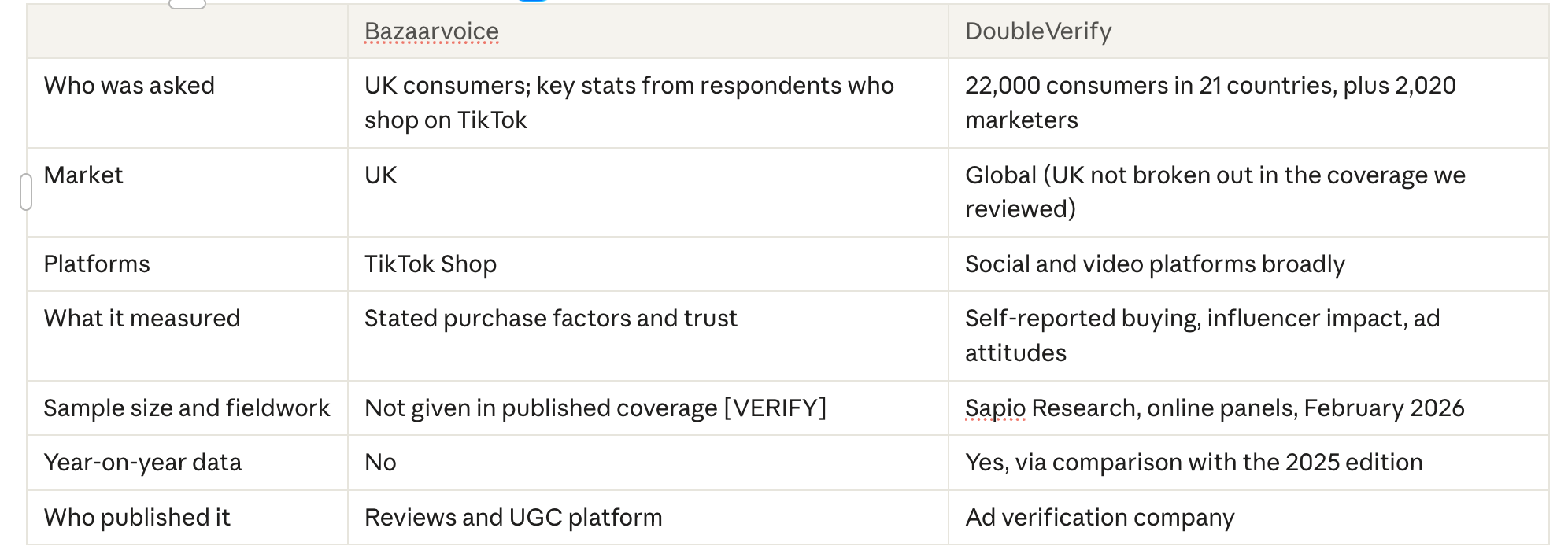
What they share matters too. Both are self-reported surveys. Both come from companies selling something related to the findings. And both point in a similar direction on stated trust, even though they measure it differently.
Key Takeaway: Use both surveys as context for a decision, not as evidence that settles it. The only data that settles your budget split is your own, measured properly.
What can't these surveys tell you?
They can't tell you what to spend. Stated trust is not the same as behaviour, and neither survey tracks real purchases against real ad exposure.
Four gaps are worth naming before anyone takes these numbers into a budget meeting:
Say versus do. Respondents can sincerely rate reviews above creators and still discover, and buy, because of a creator video. A survey answer captures the reason people give, not every reason that was at work.
Order of events. Reviews usually matter at the end of a purchase journey. Creators usually matter at the start. Asking which is "most important" collapses a sequence into a ranking.
Your category. A £12 snack and a £180 recovery device don't get bought the same way. Neither survey, in the coverage we reviewed, breaks results down by price point or category for UK buyers.
Your customers. A global average from 21 countries tells you little about a UK brand whose buyers skew to one age group or region.
So the honest position is this: the surveys tell you how people describe their trust. Your own data tells you how they behave. You need both.

Should you move budget from creators to reviews?
Not wholesale. The better question is whether you're funding the proof layer at all. Creators and reviews aren't competing for the same job, so treating them as either/or is where budgets go wrong.
Think of social commerce as a system with two layers:
The discovery layer earns attention. Creators, short-form video and paid reach live here. Its job is to put your product in front of people who weren't looking for it.
The proof layer earns the purchase. Star ratings, written reviews, customer photos and videos, and demonstrations that show the product working live here. Its job is to answer "will this actually work for me?"
The Bazaarvoice data maps neatly onto that split. Respondents credit creators with discovery (64% use TikTok Shop to find new brands) and credit other customers with the decision (74% rank reviews and ratings first). 47% said they'd be more likely to buy on TikTok Shop than from a traditional retailer if there was authentic video proof of the product.
Here's the pattern that's easy to fall into: discovery gets a budget line, a brief and a dashboard. Proof gets whatever reviews happen to arrive. That's the underinvestment.
And the DoubleVerify spend forecast sharpens the point. If social ad budgets keep growing faster than the trust measures, more money flows into attention while the conversion layer stays thin. More traffic into a product page with a handful of reviews is an expensive way to learn that proof was the bottleneck.
Key Takeaway: Don't ask "creators or reviews?" Ask "is every creator pound landing on a page with enough proof to convert?"
How do you build a proof layer that converts?
Start by treating proof as something you produce on purpose, with a budget, an owner and a brief. These are the four moves we'd make first.
Capture reviews where the sale happens. Ask every buyer for a review after delivery, on TikTok Shop and on your own site. Ask specifically for photos and video, not just stars: in the Bazaarvoice survey, customer photos and videos ranked second only to ratings and reviews. Then make that proof work twice. With the customer's permission, put real ratings, review lines and customer clips into your ads, not just on the product page.
Brief creators to make reusable proof, not just reach. Every creator brief should ask for at least one asset that works as proof: the product being used start to finish, a demonstration that answers your most common objection, an honest "what I'd want to know before buying". Secure usage rights in the contract so that content can run in paid ads and sit on product pages long after the post's organic reach fades.
Give proof its own budget line. If creators and paid have a line and proof doesn't, proof loses every planning round. Ring-fence money for review generation, customer content and proof-led ad creative, even if it starts small, and protect it long enough to measure.
Measure each layer against its own job. Don't judge a discovery creator on last-click sales, and don't judge your review programme on reach. More on this below.
Watch Out: Since 6 April 2025, the UK's Digital Markets, Competition and Consumers Act has banned fake reviews and reviews that hide the fact they were incentivised, with fines of up to 10% of global turnover. Incentivised reviews are allowed if they're clearly labelled, but lawyers advise against blending incentivised and non-incentivised reviews into one star rating. Creator content also needs clear ad disclosure. Build compliance into the programme from day one, and take legal advice on your specific set-up.
How should you measure creators, reviews and paid?
Measure each layer on the job it's there to do, then test how they work together. A single blended ROAS figure hides which layer is actually underperforming.
This is the scorecard we'd start from:
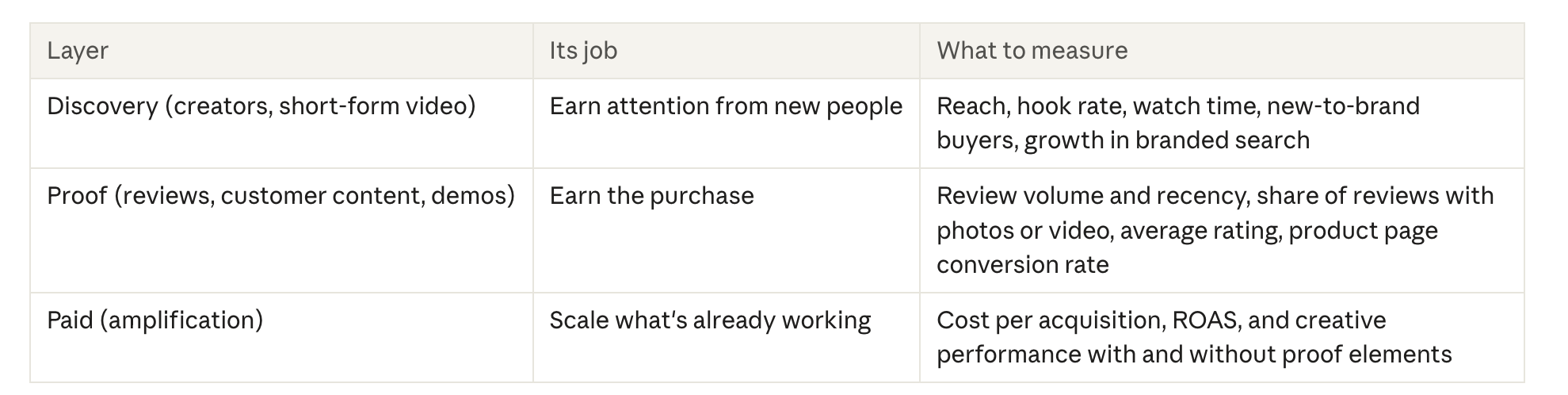
Then run the test that matters most: the same paid budget behind creative with proof built in versus creative without it. That gives you your own answer to the question the surveys can only gesture at.
It's also a problem marketers recognise. In DoubleVerify's survey, 36% of marketers named calculating ROAS or ROI as a top challenge. Clear layer-by-layer measurement is how you stop arguing about budget splits and start testing them.
Key Takeaway: If your creator spend is judged on last-click sales alone, it will look worse than it is. If your proof layer isn't measured at all, it will look like it doesn't matter. Both mistakes push budget the wrong way.
Conclusion: what actually closes the sale on social?
Proof closes the sale, and creators make sure there's a sale to close. That's the most honest reading of the evidence we have.
Bazaarvoice's UK survey shows respondents putting reviews and ratings well ahead of influencer endorsements. DoubleVerify's global survey shows reported influencer impact and social buying lower than last year's edition, while social ad spend is forecast to keep climbing. Different surveys, different questions, same tension: budgets are flowing into attention faster than into the trust that converts it.
You don't fix that by cutting creators. You fix it by building the proof layer properly, briefing creators to feed it, and measuring each layer on its own job.
If you'd like a second pair of eyes on how your budget splits across discovery, proof and paid, that's exactly the conversation we like having. Drop us a line at hello@social-climbers.com and we'll take a look at where your proof layer is working, and where it's leaking sales.

FAQ
Are customer reviews more important than influencers on TikTok Shop?
In Bazaarvoice's UK survey, respondents said so: 74% of TikTok-shopping respondents named ratings and reviews as most important, against 31% for influencer endorsements. That's stated preference, though. The same survey found creators play a big role in discovery, so the two do different jobs.
Is influencer marketing still worth it in 2026?
Yes, for discovery, provided it's measured on that job. DoubleVerify's survey reported 48% of respondents saying influencers affect their purchases, lower than the 54% in last year's edition but still close to half. The bigger risk is creator spend that isn't backed by proof on the page it sends people to.
Did social commerce drop in 2026?
In DoubleVerify's global survey, 25% of respondents said they'd bought on a social platform in the past year, against 30% in last year's edition. The report doesn't make that comparison itself and question wording may have changed, so treat it as directional rather than a confirmed decline.
Can I use paid or gifted reviews in the UK?
Only if they're clearly disclosed. Under the Digital Markets, Competition and Consumers Act, in force since 6 April 2025, fake reviews and concealed incentivised reviews are banned. Take legal advice on your set-up.
How much budget should go to reviews versus creators?
There's no universal split, and neither survey gives one. Give proof its own budget line, measure discovery and proof separately, and test creative with and without proof elements to find the right balance for your brand.
What counts as "proof" on social?
Anything that shows the product working for a real person: star ratings, written reviews, customer photos and videos, and creator demonstrations that answer genuine buying objections.
Sources
Retail Times: Customer reviews seal sales on TikTok Shop (Bazaarvoice research), 22 Oct 2026
PPC Land: Social purchases drop to 25% from 30%, DoubleVerify surveys show, 14 Oct 2026
CMS: No more faux five-stars, the DMCC Act bans fake reviews
Taylor Wessing: Fake reviews, are you ready for the new rules?
Editor notes for Emily (delete before publishing)
What I checked: I opened both source articles. Every survey number above is in them. Two corrections to the brief: the 74% and 31% come from respondents who shop on TikTok, not all respondents; and the DoubleVerify year-on-year drops are PPC Land's comparison, not DoubleVerify's, with a wording-change caveat. Both are reflected in the post.
What I added that the brief didn't have: sample size and fieldwork for DoubleVerify; Bazaarvoice's 56% customer photo/video, 64% discovery, 40% creator-triggered and 47% video-proof figures; EMEA regional figures; the 36% ROAS-challenge stat; WARC's competing 21.3% forecast; and a UK fake-reviews law section (DMCC Act), which felt essential for any post telling brands to capture more reviews.
Still to verify [VERIFY]:
Bazaarvoice sample size, fieldwork dates and question wording (ask Bazaarvoice for the full report)
Whether Bazaarvoice's "most important factor" question allowed multiple answers
Whether DoubleVerify's report breaks out UK figures
Legal sign-off on the DMCC wording and the ad disclosure line
Before publishing: add the hero image; consider internal links to related blog posts; length may run slightly over the 2,500-word target with the FAQ included, so the FAQ is the easiest place to trim.